
Your AI can't read the books you bought

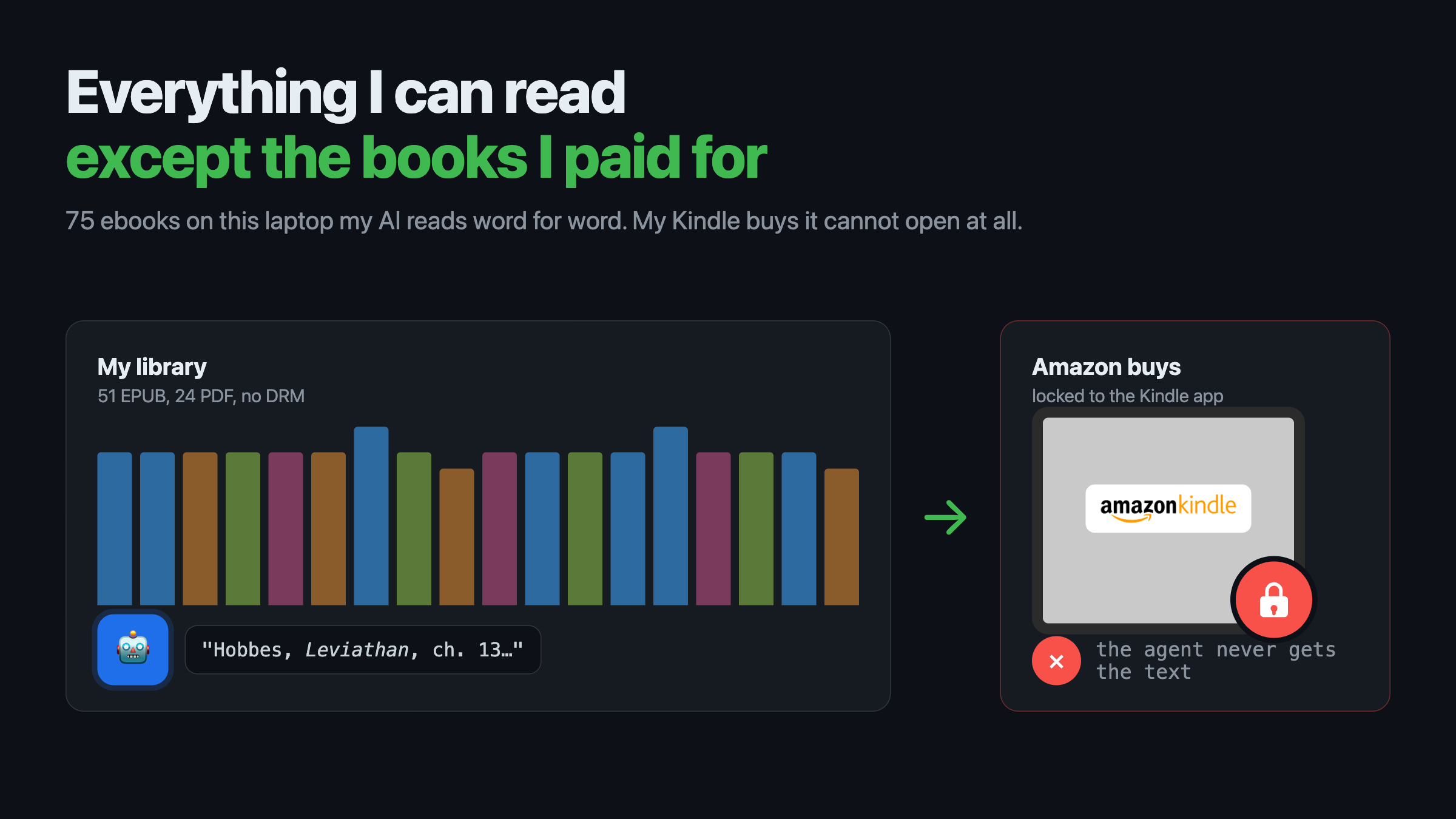
I have 75 books on this laptop that my AI agent reads word for word. The ones I bought on Kindle it cannot open at all, and those are the only ones I paid for.
Everything I own, my agent can read
The library is one folder, ~/Cloud/Books: 51 EPUB files and 24 PDFs, no DRM on any of them. The agent does not use an app to read them. It unzips the EPUB, strips the markup, and keeps the words.
One of those books, Hobbes’ Leviathan, comes out to 220,524 words of plain text. Multiply that across the folder and the agent has a few million words of searchable argument sitting on disk. Not a summary of them. The actual text, quotable, line by line.
Except the books I paid for
The books in my Amazon account are the ones the agent cannot touch.
They arrived locked to the Kindle app. There is no file on disk to unzip, no text to strip, no folder to point the agent at. To my agent those books do not exist. I can read them, on one device, inside one app, and that is the end of it.
So the asymmetry runs backwards. The books I got for free are searchable, quotable and citable. The books I paid for are a receipt and a grey rectangle.
The wall, drawn
Here is the current flow, left to right.

You buy the book on Amazon. It lands in the Kindle app. The file is locked to that app. My agent gets a red X. The one book I paid full price for is the one thing on my laptop my AI cannot search, quote or cite.
The flow I want, drawn next to it
Bottom row of the same diagram.
I ask a question. The agent searches my 75 books, finds nothing that fully answers it, and goes to the open web. It finds a book I do not own, by an author who writes about exactly this. It shows me the title, the author and the price. I say yes. It buys the rights, reads the book, and answers with a quote from it.
That purchase moment is the business. The agent already knows what I am researching, because I am the one who asked. That is better purchase intent than any advertising system has ever managed. Right now it cannot act on any of it, because there is nothing to buy that it would be allowed to read.
AI DRM, and why it is not a technical problem
The proposal is simple, and it is not DRM-free distribution. Keep the DRM. Sell a different kind.
Call it AI DRM.
Historical DRM was designed around one person, one device, one open book. AI breaks all three assumptions at once. It quotes many passages at the same time, across many books, on behalf of a process rather than a person, and it does it every time you ask a question. Every assumption the old lock rests on is gone, which is why nobody can patch the current one into working. The lock has to be rebuilt from first principles of how AI actually functions.
The principles I would build it on:
- One payment for the book, including the right for the buyer’s agent to read it. Not a rental. Not a per-read charge. Not a subscription that disappears. You buy the book, and the machine-reading right comes with it.
- After you pay, it is yours. No phone-home, no server that can switch the book off, no licence expiring in three years. I do not want to build 1984 for real. Whatever the lock is anchored to in practice, the rule is the same: once bought, the read cannot be taken back.
- The publisher still controls distribution. This is not a hole in the wall. It is a door with a lock, and the lock is attached to a purchase rather than to a device.
Notice what is missing from that list: the mechanism. How the file is bound, what it is bound to, whether there is a file at all, none of that is the interesting question. I am not going to pretend the engineering is the hard part, because it is not. The hard part is the deal.
What publishers actually sign
Publishers hear “AI reads the book” and picture their catalogue escaping into a training set. The fear is rational. The only alternative currently on offer is no DRM at all, and no DRM means one purchase becomes a thousand copies.
The version that works never releases a file. It releases a licensed read, attached to one buyer, for one agent. The publisher keeps everything the current system gives them: a sale, a record of who bought it, and a limit on how far the text travels. What they gain is the recommendation.
Think about what an AI that has just answered a question with three quotations is. It is the best bookseller ever built. It knew what I wanted before I finished typing, it found the exact book, and it can produce the passage that proves it. Today it can only show me the title, because nothing it could buy would let it read.
The winky version: if you already know where DRM-free ebooks live, you don’t have this problem. 🙂 Most people do not. The ones who pay are the ones getting locked out, and that is the part that makes no sense.